
Magento to Shopify migration

Magento to Shopify migration services

We move Magento stores onto Shopify and Shopify Plus without losing catalogue data, customers, order history or Google rankings. Your Magento store keeps selling right up to the day we switch.

  • Magento 1, Magento 2 and Adobe Commerce
  • Shopify Plus Partner
  • Fixed price, agreed before we start
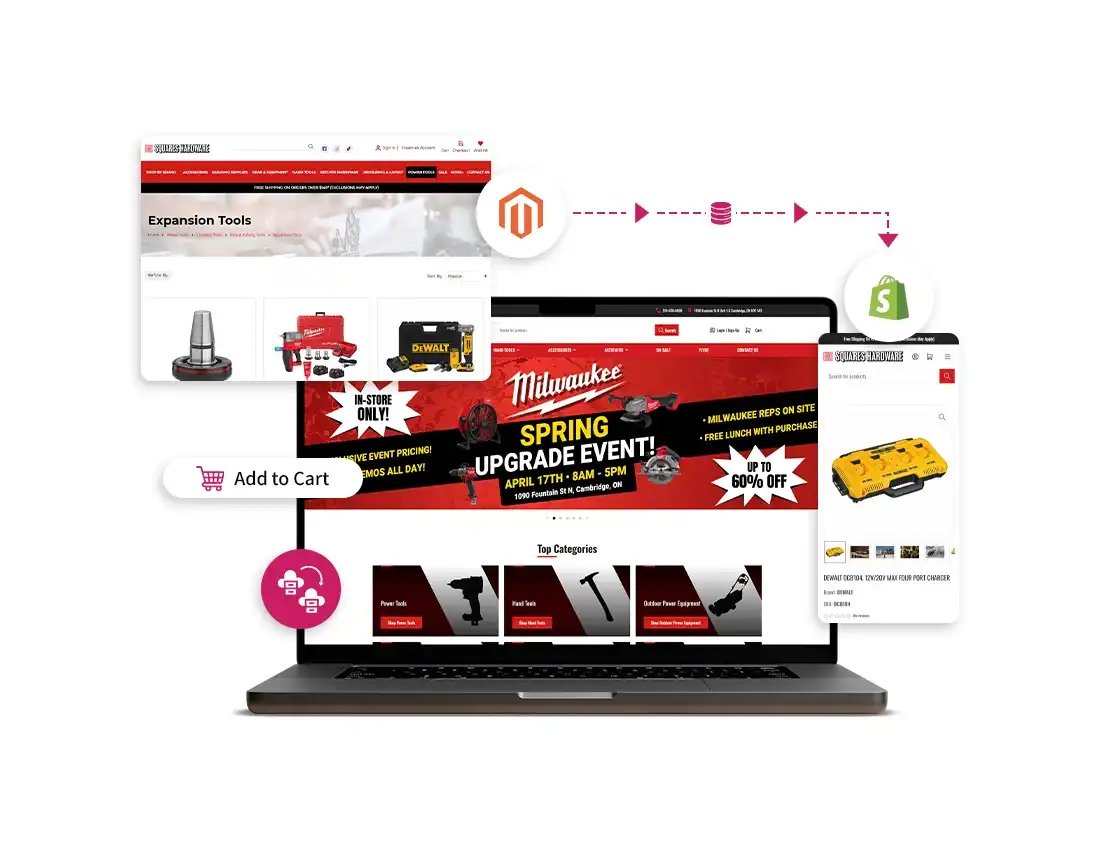
A Magento storefront and its rebuilt Shopify storefront on desktop and mobile, with the product data moving between them
100%
Products, customers and orders moved
0 min
Downtime. Magento keeps selling until cut over
1 to 1
URL redirects mapped before launch
Logo-Image Logo-Image Logo-Image Logo-Image Logo-Image Logo-Image

Track record

A Magento migration is repeat work here

The figures below are the practice a Magento to Shopify migration is delivered from.

$100M+

Client revenue generated on Shopify

Revenue our clients have taken through the Shopify stores we built and migrated. Migration work is judged on what the store earns after cut over, not on whether the records landed.

500+

Projects delivered

Builds, migrations and ongoing Shopify work across five hundred plus projects. A Magento migration is not a first attempt here, it is a repeat of a process that has been run and corrected many times.

12+

Ecommerce platforms we migrate from

Magento 1, Magento 2, Adobe Commerce, WooCommerce, BigCommerce, Salesforce Commerce Cloud and more. Knowing how each source platform stores its data is what keeps a migration from stalling halfway.

10+

POS systems we migrate from

Magento stores that sell in person carry a second system holding stock and customer history. We move that into Shopify POS in the same project so the online and in store records stay in step.

Why move

What you gain by moving off Magento

Magento gives you control and charges you for it in hosting, patching and developer time. Shopify takes that work off your plate and leaves you the part that makes money.

A Magento catalogue page beside the same catalogue rebuilt on Shopify, with an orders chart trending up
  • Hosting, patching and security stop being yours

    Shopify runs the infrastructure. No more Magento patches, no server bills, no developer on call for an update that breaks checkout.

  • A checkout that converts

    Shopify Checkout is the most tested checkout in ecommerce, and on Plus you can customise it without rebuilding it.

  • Your team can edit the store

    Shopify 2.0 sections mean merchandisers change pages themselves instead of raising a ticket and waiting a sprint.

  • Lower total cost of ownership

    Licence, hosting, patching and developer retainer collapse into one platform fee. Most Magento 1 stores find the sums obvious.

Book a migration call

Scope

What a Magento to Shopify migration covers

A Magento to Shopify migration is four pieces of work running together: moving the data, rebuilding the integrations, deciding what happens to years of custom development, and protecting the search rankings the domain has built. Magento and Shopify make different architectural assumptions, so almost nothing transfers untouched. Here is what is in scope on every project.

Data migration

What moves from Magento to Shopify

Everything in your Magento database that has a home on Shopify is migrated. Anything without a direct equivalent becomes a metafield rather than being quietly left behind.

  • Products

    Simple, configurable, bundled and grouped products, with variants, images, stock levels and every attribute you rely on.

  • Customers

    Accounts, addresses, customer groups and the history that tells you who your best buyers are.

  • Orders

    Full order history with line items, statuses, invoices, shipments and refunds attached.

  • Categories

    Category trees become Shopify collections, with the navigation rebuilt to match.

  • Cart price rules

    Coupon codes, discounts and the rules behind them, rebuilt as Shopify discounts or Scripts on Plus.

  • CMS pages and blocks

    Static pages, blog posts and content blocks, brought over with their URLs intact.

  • SEO and redirects

    Meta titles, descriptions, alt text and canonicals, plus a redirect for every old URL.

  • Custom attributes

    Attributes with no Shopify equivalent become metafields rather than being dropped.

  • Reviews

    Product reviews moved into Shopify or into the review app you choose to run.

Why Speed Plus

Why choose Speed Plus for your Magento migration

Proven migration expertise

Migrations are the work we do most, not a service line we added. We have moved catalogues off Magento 1, Magento 2 and Adobe Commerce, and we know where each one hides its complexity: attribute sets, configurable products, store views and the extensions nobody documented. See the track record.

Zero revenue loss

Your Magento store keeps selling until the moment DNS switches. We build and load the new store in parallel, so there is no maintenance window, no closed shop and no day of lost orders.

SEO rankings sustained

Every Magento URL gets a permanent redirect to its new Shopify address, meta data transfers unchanged, and structured data is rebuilt. We watch Search Console for thirty days after launch and fix what surfaces. How the SEO workstream runs.

Robust data integrity

Every record is validated against the Magento original rather than counted and assumed correct. Attributes with no Shopify field become metafields instead of being quietly dropped.

A migration built for your store

Automated tools do a generic transfer. We scope yours around your catalogue, your integrations and your B2B rules, and rebuild custom functionality as a private Shopify app where it matters. What the scope covers.

Support that does not end at launch

Thirty days of monitoring after cut over covers rankings, order flow and site speed. We decommission the old server with you, not before. The commitments we make.

Product and order records moving from Magento to a Shopify storefront on mobile

Before you start

Get the Magento to Shopify migration checklist

The thirty checks we run before moving any Magento store, from attribute sets and store views to redirect mapping and payment gateways. Use it to brief us, or to brief anyone else.

Request the checklist

No cost. We send it as a PDF.

Our migration process

How a Magento to Shopify migration actually works

Six steps, no downtime. Your Magento store keeps taking orders until the day you choose to switch.

Store review and plan

We start by reading your Magento store rather than guessing at it. We record the Magento version, catalogue size, attribute sets, extensions, store views and every integration touching the database, then write down what moves, what gets rebuilt and what is not worth carrying over.

  • Magento version and database size
  • Attribute sets and custom attributes
  • Extensions and third party integrations
  • A written scope and a fixed price

Want to see what your own migration involves?

Send us your Magento URL and version and we will come back with a written plan.

Get a free migration plan

Migration scenarios

The three shapes a Magento migration arrives in

Almost every Magento store we are asked to move is one of these three, or a combination of them. Which one yours is decides the scope, the timeline and the price.

Magento 1, past end of life

A large catalogue with no ERP

Magento 1 stopped receiving security patches in 2020, so these stores are running on an unsupported platform with extensions that no longer update. The catalogue is usually the biggest piece of work: years of products, variants and category structure built under Magento 1 conventions that Shopify does not share.

The migration rebuilds the category tree as Shopify collections, moves products with their variants and media, brings customers across with their order history intact, and maps every legacy URL to its new address.

Every product, customer and order reconciled against the Magento database before launch.

What moves across

Magento 2 with an ERP

Stock and orders flowing through a back office system

Once a Magento store is connected to an ERP or an OMS, the storefront is only half the project. Magento integrations are written against Magento's API. Shopify's is a different shape, so every connection is rebuilt rather than reconnected.

The integration audit happens in week one, not week eight. Stock sync, order routing, fulfilment status and customer records are scoped and priced before the theme build starts, so the storefront is never waiting on an integration nobody costed.

Integrations scoped and priced on day one, then built alongside the theme rather than after it.

How the process runs

Adobe Commerce with B2B

Wholesale pricing, company accounts and trade catalogues

Magento customer groups, tiered pricing and company accounts have direct equivalents in Shopify B2B, but they are not the same mechanism. A B2B store that migrates without that rebuild planned sends wholesale buyers to retail prices on launch day.

Company accounts, price lists, payment terms and catalogue visibility are rebuilt on Shopify Plus as part of the migration, then tested with real buyer accounts before cut over.

Wholesale pricing verified against live buyer accounts before the domain switches.

Common questions

SEO migration

Your Google rankings come with you

Shopify uses a fixed URL structure, so every Magento address changes. That is the single biggest risk in a replatform and it is entirely avoidable. We map a redirect for every URL before launch and watch Search Console for thirty days after.

A Shopify product page scoring 97 on performance, with structured product specifications and conversion reporting
  • A redirect for every URL

    Products, categories, CMS pages and blog posts each get a permanent 301 to their new address. Nothing is left to a catch all rule.

  • Meta data moves as it is

    Titles, descriptions, canonical tags and image alt text transfer unchanged, so pages are not re indexed from scratch.

  • Watched for thirty days

    We submit the new sitemap and monitor crawl errors, 404s and ranking movement after cut over, and fix what appears.

  • Structured data rebuilt

    Product, breadcrumb and organisation schema is rebuilt on Shopify so rich results keep showing.

Talk to us about your rankings

Which Magento you are on

Magento 1, Magento 2 and Adobe Commerce

All three migrate to Shopify. Which one you are on changes the effort, not the outcome.

  • Magento 1

    No longer patched, so staying put is a security decision as much as a commercial one. Magento 1 stores are the most common migration we run, and the data model is well understood.

  • Magento 2

    The usual comparison is Magento 2 against Shopify Plus. Magento 2 removes some Magento 1 pain but still needs hosting, patching and a developer on call.

  • Adobe Commerce

    Cloud or on premise, including B2B. Company accounts, price lists and quote workflows map onto Shopify Plus B2B rather than being rebuilt from nothing.

Cost and timeline

What decides the cost of a Magento to Shopify migration

There is no useful single price for a replatform, and anyone quoting one before seeing your store is guessing. These are the five things that move the number. We review your store and put a fixed price in writing before any work starts.

  • Catalogue size and complexity

    Ten thousand simple products is a smaller job than five hundred configurable ones with custom attribute sets.

  • Extensions and integrations

    The single biggest variable. An ERP, a PIM or custom checkout logic costs more than anything in the catalogue.

  • Design scope

    Rebuilding your existing look is one price. Redesigning while you migrate is another.

  • Store views and markets

    Each Magento store view becomes a Shopify Market with its own language, currency and pricing.

  • B2B requirements

    Company accounts, price lists, quotes and credit terms add scope on Shopify Plus.

Our Shopify expertise

What else we do on Shopify

A migration is usually the start. These are the other places we work.

  • Platform migrations

    Any platform to Shopify, from WooCommerce and BigCommerce to Salesforce and custom builds.

    See all platforms
  • Shopify POS migration

    Square, Clover, Lightspeed and QuickBooks tills moved onto Shopify POS.

    See POS migrations
  • B2B on Shopify Plus

    Company accounts, price lists, quotes and credit terms, native rather than bolted on.

    How B2B works
  • Theme and storefront build

    Shopify 2.0 themes your team can edit, built to match what you already have.

    See what we build
  • Apps and integrations

    ERP, PIM, email and custom checkout logic, reconnected and tested.

    Talk integrations
  • Migration guides

    What we have learned moving stores and tills onto Shopify, written up.

    Read the blog

Why Speed Plus

Four commitments we make on every Magento migration.

Downtime at cut over
0 min
Old URLs redirected
100%
Days of monitoring after launch
30
Price agreed before we start
Fixed

We are a Shopify Plus Partner and migrations are the work we do most. You get one team from the first store review through to the month after launch, and a price agreed in writing before anything begins.

Security

Your data is protected from the first day to the last

A migration means handing someone access to your database, your media and your admin. Here is exactly how we treat it.

  • We sign an NDA before we see anything

    No store access, no database, no screenshots until the agreement is signed.

  • A full backup before we start

    A complete copy of your Magento database and media is taken first. Nothing on your live store is changed.

  • Read only access wherever possible

    Data leaves Magento over an encrypted connection and enters Shopify through the official Admin API. We ask only for the access we actually need.

  • Nothing kept after launch

    Migration files are deleted once you confirm the new store is correct. We keep no copies.

  • Compliant by default

    A GDPR ready process, on Shopify, which is itself PCI DSS Level 1 certified.

FAQ

Magento to Shopify migration questions, answered

The questions we get asked on almost every migration call.

How long does a Magento to Shopify migration take?

Four to ten weeks for most stores, from the first review to launch. Large catalogues, several store views or a heavy Adobe Commerce B2B setup can run to sixteen. We confirm the launch date in writing before starting, not part way through.

Why is a Magento to Shopify migration more complex than moving from other platforms?

Three things happen at once on a Magento migration that rarely happen together elsewhere. Magento stores carry years of custom modules with no direct Shopify equivalent, so each one has to be decided rather than moved. Integrations are written against Magento's own API, so every connection is rebuilt rather than reconnected. And Magento URL patterns for products, categories and layered navigation differ from Shopify's, so redirects have to be mapped explicitly rather than generated. A migration from a simpler platform usually involves one of those. Magento involves all three, which is why the audit comes before the price.

Will my Magento store go offline during the migration?

No. Your Magento store keeps taking orders until the day you choose to switch. We build and load the new store in parallel on a private Shopify test store, and DNS changes only at cut over. Customers never see a closed shop.

Will I lose my Google rankings when I move from Magento to Shopify?

Not if the redirects are done properly. Shopify uses a fixed URL structure, so every Magento address changes. We map a permanent 301 for every product, category, CMS page and blog post before launch, carry the meta data across unchanged, and watch Search Console for thirty days. Most stores see a small dip for two to three weeks and then recover.

How long does organic traffic take to recover after a Magento to Shopify migration?

Rankings usually settle within 30 to 90 days when the redirect map is complete and page content carries across intact. The first fortnight looks unsettled while Google recrawls and reindexes the site. That is normal and not a sign of a problem.

We watch rankings, crawl errors and organic sessions daily for thirty days after cut over, so indexation problems get fixed while they are still small. Traffic loss that persists beyond that is almost always a missing redirect or a page that lost its content on the way across, and both are fixable.

Do you migrate Magento 1 as well as Magento 2 and Adobe Commerce?

Yes, all three. Magento 1 stores are the most common migration we run, and since the platform is no longer patched, moving is a security decision as well as a commercial one. Adobe Commerce, cloud or on premise, including B2B, is supported too.

We are still on Magento 1. Is it too late to migrate?

No, and the risk of staying is real. Magento 1 reached end of life in June 2020 and has had no security patches from Adobe since. Running an unsupported platform that handles card data is a PCI DSS problem as well as a security one, and most extension vendors stopped shipping updates years ago.

Magento 1 stores do take more work than Magento 2. The data is older, the catalogue has usually accumulated workarounds, and some of the store logic lives in places nobody documented. That is a scoping question rather than a blocker. The audit tells you exactly what your store needs before you commit to anything.

What happens to configurable products, custom attributes and store views?

Configurable products become Shopify products with variants. Custom attributes that have no Shopify field become metafields rather than being dropped. Categories become collections. Each Magento store view becomes a Shopify Market with its own language, currency and pricing.

Can customer passwords be migrated to Shopify?

No platform can migrate passwords, because they are stored hashed and are not readable. Accounts, addresses, customer groups and full order history all move. Customers get an email inviting them to set a new password, or set one at their next checkout.

We have years of custom Magento development. How much of it do we lose?

Less than most people expect, though almost none of it transfers as code. We audit every custom module during discovery and put each one in one of three places: Shopify already does it natively, an app does it well, or it needs building.

Most Magento customisation exists to fill a gap that Shopify closed years ago, so it disappears rather than being lost. Whatever genuinely needs building is priced on its own and agreed before development starts. There is no point in the project where you find out that a feature your business depends on was never in scope.

What happens to my Magento extensions on Shopify?

Most have a Shopify app that does the same job, and some are no longer needed because Shopify includes the feature. For anything genuinely specific to your business, such as B2B pricing rules, custom checkout logic or an ERP connector, we build a private Shopify app.

Do our ERP, OMS and other integrations move across in the migration?

They are rebuilt, not moved. Your current integrations talk to Magento's API, and Shopify's Admin API is a different shape, so the connection has to be written again for stock sync, order routing, fulfilment status and customer records.

We audit every integration in the first week, before any theme work begins, so the cost and the timeline are known at the start. Integrations discovered halfway through a build are the single most common reason a Magento migration overruns.

How do we move our Magento B2B wholesale setup to Shopify?

Magento customer groups, tiered pricing and company accounts all have equivalents in Shopify B2B, but they are built differently, so this is a rebuild rather than a transfer. Company accounts, price lists, payment terms and catalogue visibility are set up as part of the migration and tested with real buyer logins before the domain switches.

B2B has to be planned from the start. Leaving it until after launch is how wholesale buyers end up seeing retail prices on day one. Shopify B2B runs on Shopify Plus, so the plan decision and the B2B rebuild get scoped together.

Do you use an automated migration tool like Cart2Cart?

Automated tools are fast and they are fine for a simple catalogue. They struggle with configurable products, custom attribute sets, B2B price lists and redirect mapping, which is where most Magento stores actually live. We run the migration ourselves and validate every record against the Magento original.

How much does a Magento to Shopify migration cost?

It depends on catalogue size, the number of store views, design scope and integrations. Extensions and an ERP move the number far more than product count does. After a free review of your store you get a fixed price in writing, and that is the price you pay.

Should I move to Shopify Plus or standard Shopify?

Standard Shopify covers most stores moving off Magento 1. Shopify Plus earns its cost when you need B2B with company accounts and price lists, checkout customisation, several markets with separate pricing, or higher API limits for an ERP. We will tell you which one your store actually needs.

Insights

More on migrating to Shopify

All posts

Posts are on the way.

Start here

Get a Magento migration scope and a fixed price

Tell us what you are running on Magento and what it connects to. You get back a written scope, an integration audit and a fixed price before any work starts.

Every Magento version, including Magento 1 and Adobe Commerce

  • A written scope, listing what moves, what is rebuilt and what is replaced
  • An integration audit of every ERP, OMS and third party connection
  • A fixed price, agreed before the build starts
Next step

Ready to move off Magento?

Send us your Magento URL and version. Within two working days you get a written plan, a fixed price and a list of exactly what moves. No cost and no pressure.