
Store migration

Squarespace to Shopify migration

We move Squarespace stores onto Shopify with the catalogue, the customers and the order history intact, and every changed URL redirected before launch. Squarespace will not export your products in its site export and only lets one blog out, so the export is where most of these projects quietly go wrong. You see the full scope before you commit to anything.

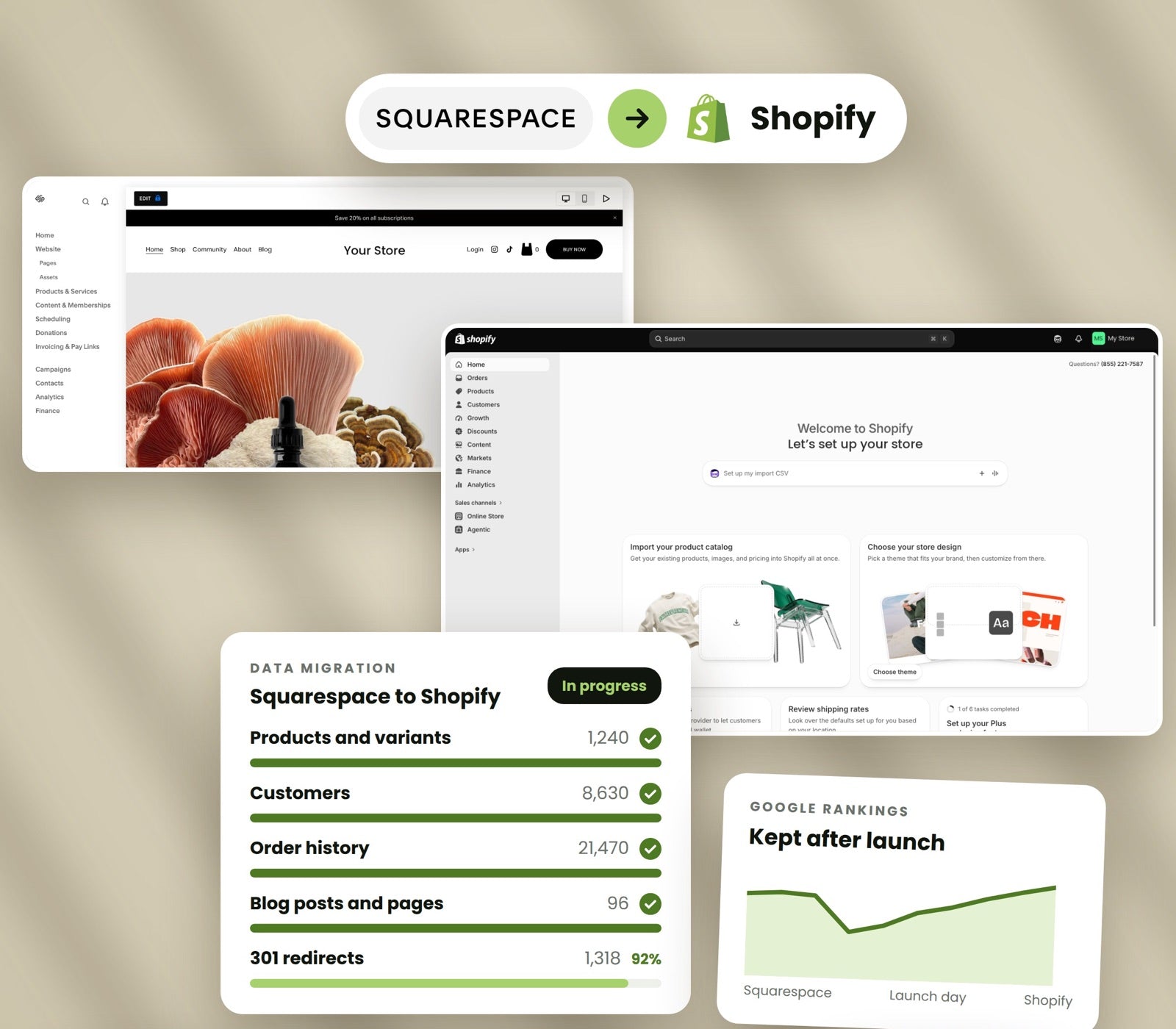
A Squarespace store and the same store rebuilt on Shopify, with a data migration panel showing products, customers, order history and redirects
100%
Order history preserved
0 min
Planned downtime
301
Redirects mapped
Partner
Shopify certified
Logo-Image Logo-Image Logo-Image Logo-Image Logo-Image Logo-Image

Why stores leave

Squarespace was built for websites, not for selling

Squarespace makes beautiful sites and the commerce layer was added to one. That order of priorities is fine until selling becomes the main thing you do. These are the four reasons owners give us.

250

Two hundred and fifty variant combinations

Squarespace caps each product at 250 variant combinations. Shopify allows 2,048. Five sizes across ten colours is already fifty, so anything with real depth meets that wall, and no setting or plan moves it.

Apps

An extensions list, not an app store

Squarespace Extensions is a short curated list. Shopify has thousands of apps competing for the same job, which keeps them maintained and honestly priced. On Squarespace you often wait for the platform or do without.

Stock

Inventory that assumes one place

No multi location stock, no proper transfers, and limited connection to retail or a third party warehouse. If you hold stock in more than one place, you are running that in a spreadsheet.

Exit

The export is deliberately thin

Squarespace exports one XML file, and its own documentation confirms that store pages and products are not in it. Only one blog page comes out. That is worth knowing before you start, not during.

What changes

What you actually gain

Four things that change how the store runs, rather than a longer feature list.

  • A platform that only does commerce

    Every release Shopify ships is aimed at selling. Nothing in the roadmap is competing with portfolios, scheduling or restaurant sites for attention.

  • Checkout that returning buyers already trust

    Shop Pay remembers buyers across every Shopify store they have used, so returning customers often check out in one tap. On Shopify Plus you can change the checkout itself, which Squarespace has never allowed on any plan.

  • Variant depth, with one trade

    Shopify allows 2,048 variant combinations per product against Squarespace’s 250. The trade is that Shopify gives you three option slots where Squarespace gives you six, so a product using four or more gets restructured into metafields or an options app. We count that at audit rather than discovering it at import.

  • Stock that matches reality

    Multiple locations, retail and third party warehouses all report into one inventory record, so what the site says is in stock is actually on a shelf somewhere.

Book a migration call

Squarespace vs Shopify

An honest comparison, including where Squarespace wins

Most pages on this subject are written to make the switch look obvious. This is the version we give people on the phone, including the two places Squarespace is genuinely better. If you are still deciding, read this part properly.

Design

Squarespace wins on design out of the box

Squarespace templates look better with no work than most Shopify themes do, and the editor lets a non developer keep them looking that way. If your site is mostly a brand presence with some products attached, that is a real advantage and it is Squarespace’s.

Simplicity

Squarespace wins on one bill and no apps

Everything is in the plan. No app subscriptions stacking up, no compatibility to think about, nothing to maintain. A Shopify store that leans on eight apps costs more and needs someone watching it. That is a genuine trade, not a detail.

Depth

Shopify wins on everything about selling

Multi location stock, B2B pricing, markets and currencies, point of sale, subscriptions, abandoned checkout flows and real reporting. These are core platform features on Shopify and either absent or thin on Squarespace.

Ceiling

Shopify wins on where it ends

The question is not which suits you now but which you will be arguing with in three years. Squarespace has a ceiling that arrives quietly, usually the week you add a second warehouse or a wholesale customer. Shopify’s is high enough that most brands never meet it.

Read this first

What the Squarespace export actually gives you

This is the part that catches people, and it is the reason a Squarespace migration is not the same job as any other. Every limit below is documented by Squarespace or by Shopify, not our opinion.

  • 01

    Your products are not in the site export

    Squarespace exports a single XML file, and its own help centre lists store pages and products among the things that file does not contain. Products come out through a separate product CSV, which caps at ten thousand products and leaves out digital downloads, gift cards, variant images and image alt text. People who treat the XML as their backup find this out at the worst moment.

  • 02

    Only one blog page comes out

    If your site has more than one blog page, the export includes one of them. The rest have to be recovered another way. If your organic traffic sits on a second blog, that is the single most expensive thing to miss.

  • 03

    Categories become Type, not collections

    Shopify’s mapping puts Squarespace Categories into the Shopify product Type field, not into collections. Import it literally and you get a flat catalogue with no browsable structure. Collections get rebuilt deliberately, which is also a chance to fix them.

  • 04

    Country is missing and required

    Shopify needs Default Address Country Code on the customer import. Squarespace does not include a country column in its export. You have to add it yourself as ISO codes, and the import fails without it.

  • 05

    Weights and stock need converting

    Squarespace records weight in pounds and Shopify wants grams, so every value is multiplied by 453.6. Stock has to have its non numeric characters stripped before Shopify will read it. Neither converts itself.

  • 06

    Orders and reviews need other tools

    Order history imports through a third party app such as EZ Importer or MigrationPro, and Squarespace exports fulfilled orders only. Reviews cannot be exported or migrated at all. Shopify states both of those plainly.

Before we quote

What we need from you to scope it

Give us these and you get a fixed price and a date instead of a range. About an hour to gather.

  • Whether your site is Squarespace 7.0 or 7.1, and which template family it uses
  • Product and variant counts, and whether anything needs more than three options
  • How many blog pages you have, and which one carries the traffic
  • How many years of order history you need to keep searchable
  • Whether you use Member Areas, Acuity Scheduling, Courses or Donations
  • Every extension and third party embed you are running
  • Your top fifty pages by traffic from Google Analytics or Search Console
  • Whether the domain was bought through Squarespace, and who can change its DNS

Data

What moves across

This part is well understood and low risk once the export is handled properly. We move it, then reconcile it against your Squarespace figures before anyone signs it off.

  • P

    Products and variants

    Titles, descriptions, SKUs, prices, vendors, tags, weights and stock, pulled through the product CSV rather than the site export. Weights convert from pounds to grams and stock is cleaned to numbers Shopify will accept.

  • I

    Product images

    Pulled at full resolution and attached in the right order against the right variant. Images landing on the wrong variant is the most common post import complaint, so we check it per product rather than by sample.

  • C

    Collections

    Rebuilt properly rather than dumped into the Type field the way a literal import would. Where a category was really a filter, we build it as one.

  • U

    Customers

    Names, emails, addresses, phone numbers and marketing consent, with the country column added and provinces converted to ISO codes, because Shopify rejects the file otherwise.

  • O

    Order history

    Fulfilled orders with line items, prices paid, dates and status, imported as archived so they never touch live stock. Your support team keeps its history and your accountant keeps the trail.

  • B

    Every blog, not just one

    The XML gives up one blog page. We recover the others by crawling the live site so posts, dates, authors and images all survive. This is usually where the backlinks are.

  • G

    Pages and policies

    About, contact, shipping, returns and the rest, rebuilt in the new theme rather than pasted in as legacy markup.

  • S

    SEO metadata

    Title tags, meta descriptions and image alt text move with the record they belong to, so work you already did is not quietly thrown away.

  • R

    Redirects

    Every old Squarespace URL mapped to its new Shopify address and loaded before launch. Shopify takes redirects as a CSV import, so the whole map goes in at once.

Reality

What does not move, and what we do instead

No tool moves these. Anyone telling you otherwise is going to surprise you later. Each one gets rebuilt, and each one is priced in the quote.

  • 01

    Your design

    Squarespace style settings and custom CSS are explicitly outside the export. A Squarespace template cannot become a Shopify theme. We rebuild the design so it reads as the same brand, which on a good Squarespace site means matching a high standard deliberately.

  • 02

    Customer passwords

    Passwords are stored hashed and cannot be read by anyone, including Squarespace. Every customer resets on first login. We send that email before launch so it reads as a planned step rather than a security scare.

  • 03

    Reviews

    Shopify states that reviews cannot be exported or migrated from Squarespace. Where they are visible on your storefront we can often recover them into Judge.me, Loox or Yotpo. Where they are not, they are gone, and we say so before you sign.

  • 04

    Member Areas and Acuity Scheduling

    These are Squarespace products, not data formats. Member Areas become Shopify customer accounts with tags or a membership app, depending on what the gating is really for. Acuity becomes a Shopify booking app chosen against how you take payment.

  • 05

    Audio, video and draft posts

    Squarespace lists audio blocks, video blocks, page specific headers and footers and draft posts among the things the export leaves behind. We recover what still earns its place and let the rest go.

  • 06

    Extension configurations

    Every extension is set up again on the Shopify equivalent. Settings, rules and stored content do not transfer between platforms, so we list them at scoping and rebuild each one.

Feature mapping

Your Squarespace features, and what replaces them

We go through this with you at scoping, feature by feature, because the answer depends on how you actually use it rather than what it is called.

  • M

    Member Areas

    Shopify customer accounts cover login, orders and addresses. Gated content or member pricing needs customer tags with theme logic, a membership app, or Shopify B2B if the gating is really wholesale.

  • A

    Acuity Scheduling

    Booking apps on Shopify handle staff, availability and deposits. Which one depends on whether you take payment up front and whether a booking consumes stock.

  • C

    Squarespace Courses

    Course content becomes a digital product plus a course app, which usually gives you more control over drip, access and pricing than you had.

  • F

    Squarespace Forms

    Form apps cover the same ground and connect to your email platform directly. Existing submissions stay in Squarespace, so export them before you close the account.

  • E

    Squarespace Email Campaigns

    Usually replaced with Klaviyo or Shopify Email. Your list moves, your sent history does not, so take a copy of what performed before you switch.

  • B

    Squarespace Blog

    Shopify blogs take the posts, tags and authors. URLs change from /blog/slug to /blogs/news/slug, so every post needs a redirect, and those posts are often your best links.

The part that costs money

Every product URL changes, and the shapes do not match

This is the biggest risk in a Squarespace migration and the one most quotes are quiet about. It is not a difficult problem. It is an unforgiving one, because the damage appears weeks later in traffic rather than immediately in a broken page.

  • Squarespace puts a /p/ in the middle

    Squarespace products sit at /shop/p/your-product. Shopify products sit at /products/your-product. You can rename the shop segment on Squarespace but the /p/ is fixed on every plan, and Shopify will not let you remove /products/ either. Both are immovable and they do not match.

  • Blogs and categories move too

    Posts go from /blog/slug to /blogs/news/slug. Category and tag pages have no direct Shopify equivalent at all, so each one needs a decision about where it should land rather than a rule.

  • Handles rewrite themselves quietly

    Shopify handles accept letters, numbers and dashes only. Accents, spaces and full stops are stripped on import, so a product called Café No. 5 does not land where you assumed and breaks a redirect you thought you had written correctly.

  • The map goes in before launch

    We crawl the live Squarespace site, pull your top pages from Search Console, and build the full map. Shopify takes redirects as a CSV import, so it all loads at once and is tested before the domain moves, not after someone notices.

Book a migration call

Free

Get the Squarespace migration checklist

The same checklist we run internally. Forty one items across export, data, SEO, extensions, payments and launch. No email wall.

Send me the checklist

We reply within one working day.

How it runs

Six stages, and what you sign off at each one

You approve the end of every stage before the next one starts. Nothing moves to your live domain until you have used the new store yourself.

Audit

We go through the Squarespace site properly: version, catalogue shape, how many blogs, extensions, traffic and where it lands. You get a written scope with everything that needs rebuilding named and priced.

  • Catalogue and variant audit
  • 7.0 or 7.1 confirmed
  • Blog and traffic audit
  • Fixed price and date

Situations

Migrations shaped like yours

Written as scenarios rather than logos. We do not publish client names or numbers without written permission, and we are not going to start on a page that is trying to win your trust.

Homeware

Three blogs, one of them exportable

Years of content across three blog pages, and Squarespace would only release one. The other two were recovered by crawling the live site before the domain moved, with every post mapped to its new address.

All three blogs preserved with redirects

Skincare

Five Squarespace options into three Shopify slots

Size, strength, scent, finish and pack size had each taken an option slot, which Squarespace allows and Shopify does not. The three driving price and stock stayed as variants, the other two moved into metafields, so nothing was lost and filtering worked for the first time.

Nothing dropped, and filtering finally worked

Studio and workshops

Acuity bookings alongside physical products

Classes were booked through Acuity while products sold through Squarespace Commerce, with no shared customer record. Rebuilt on Shopify so a booking and an order sit against the same customer.

One customer record across both

Rankings

How we protect the traffic you already have

A migration is the easiest way to lose organic traffic and one of the harder things to recover. Expect a small dip for two to four weeks while Google recrawls. Anything still down at week six is a problem, not a phase, and that is the line we hold ourselves to.

A Shopify product page scoring 97 on performance, with the redirect map beside it
  • Redirects before the domain moves

    The full map is imported and tested while the Squarespace site is still live, so the first crawler to arrive after the switch finds a clean 301 rather than a 404.

  • Metadata travels with the record

    Title tags and meta descriptions move with the product or post they belong to. Shopify will generate its own if you let it, and that is how carefully written pages quietly lose the thing that made them rank.

  • Sitemap submitted the same day

    Shopify generates the sitemap automatically. We submit it to Search Console on launch day so recrawling starts immediately rather than whenever Google next wanders past.

  • Thirty days of watching

    We check coverage, crawl errors and redirect chains daily for the first month. Most problems appear in week one and are cheap to fix then.

Talk to us about your rankings

Starting point

Which Squarespace you are on

The export path and the amount of rebuilding both change with the version. We confirm this in the first ten minutes.

  • 01

    Squarespace 7.1

    The current version. One template family, sections based pages, and Fluid Engine layouts. Product URLs always carry /p/, which cannot be removed on any plan, so every product needs a redirect.

  • 02

    Squarespace 7.0

    Older sites on one of the named template families, each behaving differently. Worth knowing which one you are on, because it changes what the layout is doing and how much of it is worth carrying over.

  • 03

    Commerce bolted onto a brochure site

    Very common. A site designed as a brand presence with a shop added later, where the catalogue structure grew by accident. The migration is the moment to fix that, and it usually costs nothing extra to do it properly.

Price

What actually drives the number

We quote fixed after the audit. These five things move the figure, so you can place yourself roughly before you speak to anyone.

  • 01

    Catalogue size and shape

    Two hundred simple products is a different job from two hundred using five options each, which Squarespace allows and Shopify does not. Option depth costs more than product count, because restructuring is where the mapping work lives.

  • 02

    How much content you are recovering

    One blog page comes out of the export. If you have three, the other two are recovered by crawling, and that is real work that scales with how much you have written.

  • 03

    How much history you keep

    Orders need a third party import tool and reconciliation afterwards. One year costs less than six, and most businesses need less than they first say.

  • 04

    Design

    Squarespace sites usually look good, which raises the bar rather than lowering it. A well chosen theme with your brand applied suits most stores. Matching an unusual layout closely is a separate line.

  • 05

    How many URLs you are protecting

    A store with a hundred indexed pages and one with eight thousand need the same care and very different amounts of time. Redirect work scales with what you have ranking.

Also

Other platforms we move stores off

The method is the same wherever you start: audit first, rebuild what cannot move, protect the URLs.

  • Wx

    Wix to Shopify

    Products, order history and every changed URL, with the Velo rebuild scoped before the price.

    Wix migration
  • BC

    BigCommerce to Shopify

    Catalogue, customers and order history, with the option and modifier differences handled properly.

    BigCommerce migration
  • WC

    WooCommerce to Shopify

    Off WordPress hosting, with the plugin stack reduced to what the business actually uses.

    WooCommerce migration
  • M2

    Magento to Shopify

    Adobe Commerce replatforming, with the extension audit done before anyone quotes a price.

    Magento migration
  • SF

    Salesforce to Shopify

    Commerce Cloud replatforming, with the cartridge and integration audit done before the price.

    Salesforce migration
  • C

    Custom and legacy builds

    Bespoke carts and in house systems, where the export has to be written before anything can move.

    Talk to us

How we work

What you get from us specifically

Minutes of planned downtime at cutover
0
URLs mapped and tested before launch
100%
Days of monitoring after launch, included
30
Price after the audit, never a range
Fixed

A migration is mostly project management with technical work attached, so what matters is what the migration company will put in writing. These are ours.

Risk and domain

Your store stays up, and the domain moves cleanly

Most Squarespace owners bought the domain through Squarespace, which makes the handover its own small project. Nothing we do touches the live site until you have signed off on the new one.

  • We build alongside, never on top

    The Shopify store is built on its own address behind a password. Your Squarespace site carries on trading and taking orders throughout.

  • Domains bought through Squarespace

    You can either transfer the domain to Shopify or leave it registered where it is and point it. Transferring means removing the registrar lock, turning off privacy, and taking an authorisation code, and a domain registered or renewed in the last sixty days usually cannot be transferred yet. We check that early, because it sets the launch date.

  • Two imports, not one

    The first import is a trial we expect to find problems in. We fix the mapping, wipe it, and run it again clean, so launch day repeats something that already worked.

  • The cutover is planned, not hoped

    We disconnect the domain from Squarespace in the right order before pointing it at Shopify, which is what prevents the certificate errors that make a new store look broken. DNS can take up to forty eight hours to settle, so we plan around that.

  • A way back

    Keep the Squarespace plan running for a month after launch. It costs very little, it keeps your original content and reviews reachable, and it means a bad week is recoverable.

Questions

Squarespace to Shopify migration questions

The questions we are actually asked, answered properly.

How long does a Squarespace to Shopify migration take?

Two to three weeks for a straightforward store of a few hundred products with one blog. Four to eight weeks where there are several blogs to recover, deep variants, years of order history, Member Areas or Acuity, or a design that has to be matched closely. The audit gives you a date rather than a range.

Will my SEO rankings drop after migrating?

Expect a dip of two to four weeks while Google recrawls and passes authority through your redirects. That is normal and it recovers. What is not normal is still being down at week six, which almost always means missing or broken redirects. The redirect map is the highest value part of this project.

Does Squarespace export my products?

Not in the site export. Squarespace exports a single XML file and its own help centre lists store pages and products among the things that file does not include. Products come out through a separate product CSV. If you assumed the XML was a full backup, check this before you cancel anything.

Can I export all my blog posts?

Only one blog page. Squarespace states that if your site has more than one blog page, only one can be exported. The others have to be recovered another way, normally by crawling the live site before the domain moves. If your organic traffic sits on a second blog, this is the most expensive thing to miss.

Can my customers keep their passwords?

No, and no platform can do this. Passwords are stored as one way hashes nobody can read, including Squarespace. Every customer resets on first login. We send that email before launch and explain it as a planned step, which turns it from a support problem into a non event.

What does a Squarespace to Shopify migration cost?

It depends on catalogue shape, how much content needs recovering, how much order history you keep and how many URLs you are protecting. We quote fixed after the audit rather than publishing a table, because a table would be wrong for most stores that read it. The audit is free.

What data can actually be migrated from Squarespace?

Products and variants, images, customers, fulfilled order history, blog posts, static pages and SEO metadata. What cannot move is your design and custom CSS, reviews, customer passwords, extension configurations, and audio, video and draft posts. Shopify states plainly that reviews cannot be exported or migrated from Squarespace.

Do I have to take my Squarespace site offline during the migration?

No. The Shopify store is built on a separate address behind a password while your Squarespace site keeps trading. The only moment anything changes for customers is the cutover, which we schedule for a quiet hour and which involves no planned downtime.

How do I transfer my domain from Squarespace to Shopify?

Two options. You can transfer the registration to Shopify, which means removing the registrar lock in Squarespace, turning off privacy protection and getting an authorisation code, then starting the transfer on the Shopify side. Or you can leave it registered with Squarespace and simply point it at Shopify by changing the DNS records. Pointing is faster and perfectly fine. One catch either way: a domain registered or renewed within the last sixty days normally cannot be transferred yet, so we confirm that before setting a launch date.

Will my Shopify store look the same as my Squarespace site?

It will read as the same brand, but it will not be pixel identical. Squarespace style settings and custom CSS are explicitly excluded from the export, and a Squarespace template cannot become a Shopify theme. We rebuild the design in Shopify’s section structure. Squarespace sites usually look good, so we treat that as the standard to meet rather than a constraint to work around.

Can I keep my Squarespace URLs so nothing changes?

No, and this one is unusually rigid on both sides. Squarespace puts /p/ into every product URL and it cannot be removed on any plan or with any extension. Shopify requires /products/ and will not let you remove that either. The two shapes cannot be reconciled, so the answer is not to preserve URLs but to redirect every one of them, which preserves the rankings instead.

What happens to my product categories?

Shopify’s own mapping puts Squarespace Categories into the product Type field rather than into collections. Follow that literally and you end up with a flat catalogue nobody can browse. We rebuild collections deliberately, which is also the moment to fix a category structure that grew by accident.

Are there conversions I need to know about in the CSV?

Three. Squarespace records weight in pounds and Shopify wants grams, so values are multiplied by 453.6. Stock has to have non numeric characters stripped before Shopify will read the column. And Shopify requires a country code on the customer import that Squarespace does not export at all, so that column has to be added by hand as ISO codes or the file is rejected.

Can I move my product reviews?

Not through any supported export. Shopify says directly that you cannot export or migrate reviews from Squarespace. Where reviews are publicly visible on your storefront we can often recover them and load them into Judge.me, Loox or Yotpo. Where they are not visible, they are lost, and we tell you before you sign rather than after.

Do you migrate order history, and does it affect my stock?

Yes, and no. Historic orders import as archived records, fully searchable by customer, product and date but never touching live inventory. Squarespace exports fulfilled orders only, and Shopify’s native CSV import does not accept orders at all, so this runs through a dedicated tool such as EZ Importer or MigrationPro and is then reconciled against your Squarespace totals.

What about Member Areas, Acuity and Courses?

All three are Squarespace products rather than data you can export, so all three get rebuilt. Member Areas become Shopify customer accounts with tags or a membership app. Acuity becomes a Shopify booking app. Courses become a digital product plus a course app, which usually gives you more control over access and pricing than you had.

Do I need a Squarespace to Shopify migration agency, or can I do this myself?

You may well not, and we would rather say so. A small catalogue, one blog, no order history worth keeping and no Member Areas is a weekend of careful CSV work, and you should keep your money. The things that make people hire an agency are the export gaps, several blogs to recover, order history, and a site with real search traffic where the redirect map is the whole ball game.

Is Shopify more expensive than Squarespace?

Usually yes, once apps are included, and pretending otherwise would be dishonest. Squarespace bundles more into one plan. The question is whether what you gain pays for that, which depends entirely on your volume and what you are currently working around by hand. If nothing about Squarespace is actually blocking you, the honest answer is to stay.

What happens to my Squarespace subscription after I migrate?

Keep it running for about a month after launch. It is inexpensive next to the cost of needing something you deleted, it keeps your original content and reviews reachable, and it gives you somewhere to check against if a number looks wrong. Cancel once you have traded happily on Shopify for a few weeks. If you transfer the domain away, do that before you cancel.

Other agencies say they migrate everything. Who is right?

Check it against Shopify’s own migration documentation, which states that reviews cannot be exported or migrated from Squarespace, and against Squarespace’s help centre, which confirms products, store pages, custom CSS and all but one blog are outside the site export. Any page promising that everything transfers is either counting a manual rebuild as a migration or has not checked.

Squarespace lets me use six product options. What happens on Shopify?

This is the real trap in a Squarespace migration, and it runs the opposite way to what people expect. Squarespace allows up to six options per product but caps you at 250 variant combinations. Shopify allows three options and up to 2,048 combinations. So you gain enormous depth and lose three option slots at the same time. Any product using four or more options has to be restructured: the options that actually drive price and stock stay as variants, and the rest move into metafields or a product options app. We count these at audit, because finding them at import means rebuilding products by hand.

What happens to my digital downloads and gift cards?

Neither is in the Squarespace product CSV, so both are recreated by hand. Digital products become Shopify digital products with a delivery app, which is usually an upgrade because you get download limits and delivery tracking you did not have. Gift cards matter more than people expect: an unspent balance is money your customers are owed, and if the cards are not reissued on Shopify with the right balances, those customers turn up holding something you cannot honour. We pull the outstanding balances and reissue them before launch.

Will my product images and alt text come across?

Not all of it through the CSV. The Squarespace product export leaves out variant images and image alt text, so a literal import gives you products with one image and no alt attributes. We pull the images directly and reattach them against the right variant, and carry the alt text with them, because alt text is both an accessibility requirement and a ranking signal you already paid for.

Who owns the Shopify store and the work afterwards?

You do. The Shopify account is in your name and billed to you from the start, and we work inside it as staff. Theme code, redirect maps and migration scripts are yours and handed over at the end. You can take the store to another agency or run it yourself without asking us for anything.

Insights

More on migrating to Shopify

All posts

Posts are on the way.

Start here

Get a Squarespace migration plan

Send us your Squarespace address and we will come back with what moves, what needs rebuilding and what it costs. No obligation and no pressure. If you are better off staying on Squarespace we will tell you.

  • A written scope of what moves and what gets rebuilt
  • A fixed price and a launch date, not a range
  • An honest answer on whether you should migrate at all
Squarespace to Shopify

Move the store without losing the rankings

Our Squarespace to Shopify migration service covers the catalogue, the customers, the order history, the content the export leaves behind, and the redirects. You keep trading on Squarespace until the day it switches.